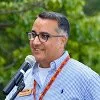
Voice of God | A Tribute to Paul
I actually started writing this back in August, when I learned that Paul Reichenbach was sick with ALS. I wasn't writing an obituary, and I certainly wasn't ready to contemplate that I might be finishing it so soon after he was gone. I felt an immediate need to start putting down some thoughts about this remarkable, complex, and incredibly important man and what he has meant in my life. I reached out to Paul right away, and I am so grateful that I did. We stayed in touch by text over the last couple of months, sharing memories and a few laughs, and I got to tell him some things that mattered to me. But I never got to speak with him again, and of all the cruelty of ALS, there is something particularly cruel about a disease taking away Paul Reichenbach's ability to speak. Because if you knew Paul, you knew that fucking voice.
Paul died today, far too soon after I learned he was sick. I wish we had been given more time. I wish his family had been given more time, and selfishly, I wish I had been. I wish I could have seen him again and heard his voice one more time. At the same time, there is something terribly bittersweet about imagining someone as strong and vital as Paul being slowly weakened by this disease for years. ALS is cruel, and there isn't anything profound I can offer that makes that less true. I am grateful that he did not have to endure a prolonged decline, and heartbroken that the alternative was losing him so quickly.
Paul was one of my favorite colleagues of all time, a great friend, and one of the most important mentors I ever had. It is not hyperbole to say that if not for Paul Reichenbach, I would not be where I am today. I would never have become the director of URJ Camp Harlam. I wouldn't have spent nine years working for the Union for Reform Judaism. And without those nine years, I probably wouldn't have eventually left that world and followed the strange path that ultimately led me to owning and directing a private camp. My professional trajectory is different, and some argue it all happened because Paul once said, "Hmmm…"
If you knew Paul, you know that he could communicate an incredible amount with that one sound. In fact, you probably just heard it in your head. My first memory of Paul is similar to how I imagine many people first experienced him. I was sitting in some giant hotel ballroom at some conference when suddenly it sounded like God was speaking. This was not a spiritual experience. I'm not a particularly spiritual person. It was Paul Reichenbach. His voice was deep and booming and somehow sounded all-knowing. Today's generation has Siri. We had PJR. Paul was Siri before there was Siri, except Paul sounded smarter than Siri and certainly was.
The funny thing about that voice was that it suggested a guy who was going to tell you exactly what to do, and Paul certainly knew enough to do that. He had seen more than most of us. He knew the Reform Movement, Jewish camping, and youth work. He knew the history, the people, the politics, and the personalities. In a lot of rooms, Paul actually did know better than you. But that wasn't how he led. He left space. He listened and let you make your argument. He let you advocate and disagree. There were times when I am pretty sure he already knew exactly where he wanted something to end up, and probably others when someone above him had already decided where it was going to end up, and poor Paul had been given the unenviable assignment of getting the rest of us there. But he still allowed for process.
I really got to know Paul around 2009 when I was working for JCC Association of North America. Part of my portfolio was overseeing camping, which occasionally put me together with Paul and Mitch Cohen, who oversaw the Ramah camps. I remember thinking it was kind of ridiculous that I was supposed to be their colleague. Paul and Mitch and me? Come on. Those guys knew things. They understood movements and systems and people; they had history together, and I was the outsider who had somehow gotten a seat at the table. But they let me in, and eventually Paul and I developed a rhythm of seeing one another every once in a while and comparing notes about what was happening in our respective camping systems.
One of my favorite early memories was when Paul invited me to lunch with him and Mitch as we prepared for the summer of 2009. Swine flu had arrived and, for those who don't remember, it was briefly going to end civilization. This was before COVID taught us what a pandemic could actually look like and long before any of us had ever heard of the Shapsel brothers (too soon?). We were talking about what our organizations were doing to support camps and, in particular, what the three of us were going to do as we traveled around visiting them. Paul and Mitch had a plan: Tamiflu. They were going to take it prophylactically while traveling, apparently turning themselves into some kind of Jewish camping superheroes. I knew virtually nothing about Tamiflu and had absolutely no idea whether this made any medical sense whatsoever. Naturally, I was prepared to do exactly what they were doing, because if Paul Reichenbach said this was what we were doing, apparently I was taking Tamiflu.
Years later, after I became the director of Harlam, I was in the basement of one of our buildings and discovered cases of Tamiflu. Cases and cases. Apparently, when Paul had talked about stockpiling Tamiflu, I had significantly underestimated the seriousness of the operation. I think he may have attempted to purchase every available dose in the northeastern United States. It was such a perfect Paul thing: preparation, responsibility, a little bit of overkill, and an absolute determination that if something happened at one of his camps, he was going to be ready.
The conversation with Paul that really changed my life came in the fall of 2010. I was trying to identify candidates for the executive director position at Tamarack Camps, and Paul was involved in another search. We compared notes and commented on how surprisingly few candidates there seemed to be when he asked whether I had ever thought about going back into camping myself. I had a rehearsed answer. I had been a camp director before, and when I left that job I was pretty convinced it would be the last camp I ever directed. The truthful answer was that there was no way I was doing that again. But that wasn't a particularly credible position for someone who was now being paid to be an expert and consultant in the camping field, so I had developed something that sounded better.
I told Paul I would absolutely consider becoming a camp director again, but only if I could run a really big camp, go somewhere with an opportunity to do things nobody had done before, and somehow do all of that without moving my family from West Philadelphia. It was a fantastic answer because I had constructed conditions that I assumed no actual job could possibly satisfy. I finished my little speech, and there was silence on the other end of the phone. Then Paul said, "Hmmm…"
That was it. He never said Camp Harlam. He didn't need to. If you knew Paul, you knew that "Hmmm" could be an entire paragraph. Suddenly I knew exactly what he was thinking. A camp actually fit my stupid conditional answer. I had never bothered to consider whether such a place existed because I had designed the answer specifically so it wouldn't. I hung up with Paul and immediately called Ann, and she can attest that this was basically it. Paul said, "Hmmm," and suddenly I was contemplating leaving a great job at an organization I cared deeply about, where I had lots of opportunity for continued growth, and dusting off my camp director clipboard, notebooks, and pens. That son of a gun made me reconsider my entire professional future with one sound.
I spent the better part of the next nine years working for Paul, and those years were among the great leadership educations of my career. Paul came from a different generation of Jewish youth leadership. He had been raised at the feet of some extraordinary leaders of the Reform Movement and had lived so much of its history himself. There was NFTY and Kutz, Israel programs and the camping system, and people like Alan Smith and Arie Gluck. Paul had been the trusted consigliere before eventually ascending to the mantle of leadership himself. What impressed me, though, was that he didn't simply replicate the leadership he had experienced. He evolved. By the time I came along, he had developed a nuanced, thoughtful, and deeply caring way of leading that was different from some of the institutional models that had preceded him.
Consider for a moment the group Paul supervised: camp directors. Men and women with strong opinions, strong personalities, strong egos and, let's acknowledge it, a fairly healthy amount of self-importance. Every one of us spent our summers running our own little worlds. Hundreds of campers, hundreds of staff, thousands of parents, big budgets and big decisions. We were used to being in charge, and then poor Paul had to be in charge of us. What I appreciate much more today than I did while I was living it is how skillfully he managed that. He gave us enough space to retain a genuine sense of agency. He allowed us to feel the strength, power, and influence that came with leading our own camps, and he was never threatened by it. He didn't have to diminish us to establish his own authority. And yet, there was never really any question that he was leading us.
And, gee whiz, did we make that man work. We screamed and yelled, bitched and moaned, complained about what wasn't fair, and explained endlessly why our camp was different. Every one of us could make a remarkably compelling case for why our particular situation was unique and therefore whatever rule applied to everyone else obviously shouldn't apply to us. Paul put up with an enormous amount of bullshit, but somehow he kept getting us back to the table. Sometimes we came kicking and screaming, but we came back.
While we were fighting our individual battles, Paul helped move an entire camping system forward. Some things about the URJ camping system were broken. We fixed some of them and left others, and for all I know, some are still broken today. But Paul mended an awful lot. He helped move our camps into a new era of technology and digitalization, helped change our understanding of philanthropy and what it could mean for our camps, and pushed us toward more sophisticated systems and a more complex, nuanced understanding of leadership itself. More importantly, he modeled that leadership for us. Give talented people room. Let them own their work. Don't confuse supervision with control. Allow strong leaders to be strong. Listen longer than may seem reasonable. Keep people at the table. Don't make disagreement the same thing as disloyalty. And understand that sometimes the people with the greatest capacity are also going to be the biggest pains in your ass. I may have provided Paul with particularly good practice on that last one.
Sometimes Paul protected me from the organization, sometimes he protected the organization from me, and plenty of times he protected me from myself. I had then — and still have now — a crusader mentality. When I thought something was right, I was ready to charge. Paul never tried to take that away from me. He understood that it was part of what made me effective. He just helped make sure that I didn't kill myself or too many innocent bystanders in the process. That was part of his gift as a supervisor: he didn't try to turn strong people into easier people to supervise.
But his kindness and patience should never be confused with weakness. When the hard conversation needed to happen, Paul had it. I sat with him for some of those conversations and discussed others with him before or after they happened. As experienced and proud as he was, he was also willing to ask for help. I watched him make difficult decisions involving people he genuinely cared about. He mended, fixed, cajoled, and cared, but he also didn't put up with too much shit. There were a lot of talented people in those rooms, a lot of big personalities and people who were accustomed to everyone else listening when they spoke. Through it all, Paul was always an adult. Sometimes he was the only one in the room.
Paul also taught me about leadership through the people he loved and trusted. He loved Debby Shriber, and I love Debby, too, which somehow made me care about Paul even more. He cared deeply about Melissa Frey. He saw the talent in Lisa David, and when the crazy idea emerged of Lisa coming to work with us at Harlam, Paul gave it his blessing because he believed in Lisa. So did I. He adored Miriam Chilton, and together they pushed our camping system and all of us as directors in deep and timely ways. Miriam and I did not always see the world the same way, to put it diplomatically, and there were certainly times when Paul protected us from each other. But I respected her so much, and one reason was that Paul respected her. And all of these women Paul cared about were the best examples of what was right with the URJ (in my humble opinion). Paul championed each one of them.
Then there were my buddies — Louis, Bobby, and others — who also understood what it meant to have Paul looking out for us. I've been thinking about that word "protector," because Paul certainly was one for many of us. But I think he was also our projector. He could look at people, recognize something in them, and project forward to what they might become. He did that for me. We did a lot of work together during those nine years, some of it right out in front and a lot of it behind the scenes. I could even go to my boss and tell him about other jobs that interested me, and Paul would talk them through with me. He didn't turn those conversations into tests of my loyalty to him or the organization. He cared about me and about my life. He helped me think, kept me grounded, and made me feel safe.
Shortly before Paul retired, he gathered a group of us in a circle outside at Kutz Camp at dusk and officially told us he was leaving. He had shared the news with me privately before that and, in that earlier conversation, shared some very personal thoughts about his future and mine. I left there believing that fate might eventually have me follow Paul into his role. As it turns out, that didn't happen. I'm quite certain it was for the best. By then, though, Paul had already given me something much more valuable than his job. He had given me his confidence, his trust, his protection, and his example. Most of all, I knew Paul loved me. That's not something I say casually. I knew it, and I loved him.
Harlam was always a special place for Paul, and that meant so much to me, to Lisa, and to so many others. Even after his official retirement, when we caught up and he told me about camps he had visited, it was obvious how much he still had to give and how much this work remained part of him. Retirement could end his job, but it couldn't end his relationship with camp. And then there was his family. Oh, how Paul loved his children and grandchildren. For all the people he mentored and the lives he touched professionally, there was never any question about the enormous place his family occupied in his life.
There are people who can write much more authoritatively than I can about Paul Reichenbach's place in the history of the Reform Movement. People knew him decades before I did and can tell the Kutz stories, the NFTY stories, and the Israel stories. They can describe his impact on generations of young people and the enormous footprint he left on Jewish camping and youth engagement. I came into Paul's professional life relatively late. What I can tell you is what he did for me, and what I learned from watching him do the same thing for so many others.
Paul changed my life, but he never sat me down and mapped out a career for me. He saw me, believed in me, trusted me, and gave me room. He challenged me when I needed challenging and protected me when I needed protecting. He tolerated my ego, my crusades, and my certainty that whatever I happened to be worked up about at that particular moment was obviously the most important problem confronting the Reform Movement. Somehow, without trying to make me into someone else, he helped me become a better leader. More than fifteen years after that phone call about Harlam, I can see pieces of Paul in the way I try to lead people today.
I wish I had more time with him. I wanted another visit. And I really, really wanted to hear that fucking voice one more time.
Maybe that's why I keep coming back to that phone call from 2010. I can still hear myself giving Paul my carefully rehearsed explanation of all the conditions that would have to exist for me to ever consider directing a camp again, completely confident that I had constructed an impossible scenario. I can still hear the silence on the other end. And then I can hear Paul Reichenbach, in that unmistakable voice, saying one thing.
"Hmmm…"
I heard you, PJR. Thank God I did. I love you, my friend. And I will miss that voice forever.